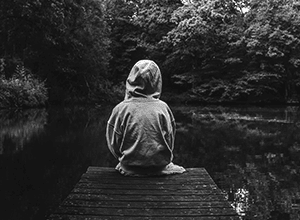
S R EUNITED He finds his mother after 50 years Text: Otto Hostettler Photo: Vera Hartmann Santosh Ritter was taken from his mother in India as a baby and brought to Switzerland for adoption. Fifty years later he is the Swiss CEO of a globally active tech company — and receives a long-awaited phone call. antosh Ritter had always believed it would happen. But he never really counted on it. At the end of March, the 48-yearold met his biological mother in a suburb of Mumbai, India’s metropolis of 15 million. He can barely put his feelings into words. He scrolls through the stream of images on his phone: crowds of people in India. He gets out of a car. He walks toward a woman in colourful clothing. The two embrace. They stand side by side awkwardly, beaming. The mother takes her son by the hand, and they walk to the house. After almost 50 years they are reunited — for a brief moment, at least. Ritter posts no pictures of this meeting on social media, nor will they be published in Beobachter. That was his promise to his mother. Because no one in her current family knows about him, about her illegitimate son in Switzerland. In the patriarchal system she would likely be cast out of the family and would lose her social standing — with unforeseeable consequences. The first trip to India Nearly 30 years ago, Beobachter once reported on Santosh Ritter before. Brought to Switzerland in 1980 at the age of two, adopted by a couple from the canton of Zurich, he called himself Matthias back then. He described how, at 18, he had just travelled to India for the first time — because he had wanted to know who he was, and above all to find his mother. The search in India was unsuccessful at the time. He did find the Catholic children’s home where he had lived together with his mother for two years after his birth. He even met a nun there who remembered his mother. But he was told there were no longer any records about him, and no one knew where his mother lived. It was better for everyone anyway, he was told, not to keep searching for her. Adoptions from India were carried out in a particularly questionable manner until the 2000s. Indian courts did approve the babies’ departure, but they kept the documents about the biological parents under seal — if any such documents existed at all. The Swiss authorities therefore had no declarations of consent from the mothers — yet they still authorised entry into the country and later the adoption. Swiss researchers exposed this questionable system in their 2024 study «Mother Unknown» (Mutter unbekannt). Santosh Ritter returned to Switzerland disappointed after that first trip to India. «That was hard for me. I was closer to my mother than ever since we’d been separated, and yet further away than ever,» he said at the time to Beobachter, but he also made clear: «If my mother is still alive, I will find her.» His difficult childhood As a child he lacked that self-confidence. And even today he finds it hard to talk about his childhood. The centre of his adoptive parents’ life — and thus of his own — was a fundamentalist free church. They had six children, three of them adopted. «No child should have to go through what I went through,» he says today. At 16 he moved out of the family home. His trip to India at 18 awakened a new sense of self. «For the first time in my life, I wasn’t stared at on the street.» Back in Switzerland, he now no longer called himself Matthias, but Santosh — as it had once read on his Indian passport, and as his biological mother had called him. He completed a commercial apprenticeship (KV) and went through Swiss military recruit training. In the military uniform he suddenly had a different effect on people. All at once he got his change handed to him at the kiosk. Before, the salespeople had simply set it down on the counter. On the train, the conductor greeted him warmly. Without the uniform he had often had to explain himself — even though he had a ticket. Racism was something he had known since his Beobachter 11/2026 23Santosh Ritter childhood. He was teased and attacked because of his skin colour. Once it landed him in the hospital. But at work Ritter was in demand; he threw himself into it, studying for a degree on the side while working. Then there was music: techno, house, his own parties, a radio show. On top of that he competed in snowboarding. The insecurity of his youth flipped into its opposite. Today he says: «It was a life in the fast lane.» A consequential accident At 26, it was a split second that literally turned his life upside down. A backflip on the ski slope at Alt St. Johann in the Toggenburg went wrong. Ritter suffered multiple pelvic fractures. «That fall completely changed my life.» He says he literally came back to himself — with humility and also with gratitude. He fought his way back to life and built a career. But he couldn’t shake his past: «I thought about my mother every single day.» Yet from Switzerland there was no way for him to achieve anything. So over the years he travelled to India several times. He visited the children’s home again and hired local lawyers. Without success. There was no point, either, in requesting access to records by letter in India. «Nothing happens at all there.» Then, three years ago, another turning point: by now he had become the Swiss CEO of a globally active tech company, with offices not far from Zurich’s Paradeplatz. At an internal company symposium of top executives in the USA, he sat on the panel and told his story: of his Indian origins, the adoption to Switzerland, of his undignified childhood, the exclusion, the racism — and of his unsuccessful search for his mother. Ritter was met with a wave of compassion: «At the end everyone stood up and applauded. Many people were in tears.» The experience drove him to take up the search once more. Online he found other adoptees — and came across Arun Dohle. The 53-year-old had also been placed for adoption from India, though to Germany. In his own search for his origins, Dohle had taken legal action against the Indian authorities. That is how he eventually obtained his adoption papers — and found his mother. Today Dohle lives in India and runs the organisation Against Child Trafficking. His no-nonsense approach with the Indian authorities also brought about the breakthrough for Santosh Ritter. «I felt a deep calm and an intense peace.» Arun Dohle and his organisation kept pressing the children’s home where Santosh Ritter had been until it finally handed over the documents about his mother. «We were just a hair’s breadth from filing suit,» Dohle says in hindsight. His life partner — a lawyer and trained Indian social worker — finally found Ritter’s mother, under a new name, in that suburb of Mumbai. Then the phone rang On the day Arun Dohle’s breakthrough came, Santosh Ritter happened to be in a music studio in Zurich with friends. Rather than writing a book about his story, he had a musical reckoning in mind. They had just been discussing how he might express his feelings musically, should he, after 50 years, come face to face with his own mother, Ritter recalls. «At that very moment, my phone rang.» On the other end were his trusted people in India — and they pointed the phone’s camera at a woman: «It was my mother.» «In that moment I felt an infinitely deep calm and an intense peace within me,» Ritter says. A good three months later, in India, Santosh Ritter embraces the woman from whom he had been separated almost 50 years earlier — and whom he had searched for over 30 years. She tells him how, as an unmarried 16-year-old, she lived together with him for two years in the Catholic home. No, she says, she never gave her consent to the adoption. Every night he, her boy, had lain beside her; she had not left his side. But one morning he was gone. ■ Beobachter first reported on Ritter’s search for his mother in 1998. (Original 1998 headline: «Matthias Ritter: I was a different person») To find biological parents — helpful links here: beobachter.ch/ind
He finds his mother after 50 years